實作範例 · Word 修訂標記,然後轉譯為波蘭語
將一份給家長的健康信件簡化並使用修訂追蹤,然後翻譯成波蘭語
一個地方健康保護團隊收到英國健康安全局(UK Health Security Agency)針對學校出現腦膜炎雙球菌疾病病例時發給家長的範本信件。他們要求 將其改寫,以便讓識字率較低的家長能夠閱讀,並以同一個 Word 檔案中的修訂標記呈現,讓他們的顧問可以選擇接受或拒絕每一處編輯。
將內文改寫為短句,並保留了所有醫學事實、標題、聯絡資料和樣式。顧問接受變更後,將他們的兩處編輯作為新的修訂標記,並為一所擁有許多波蘭裔家庭的學校製作了乾淨的波蘭語譯本。
1UKHSA 信件範本:長句和醫學用語
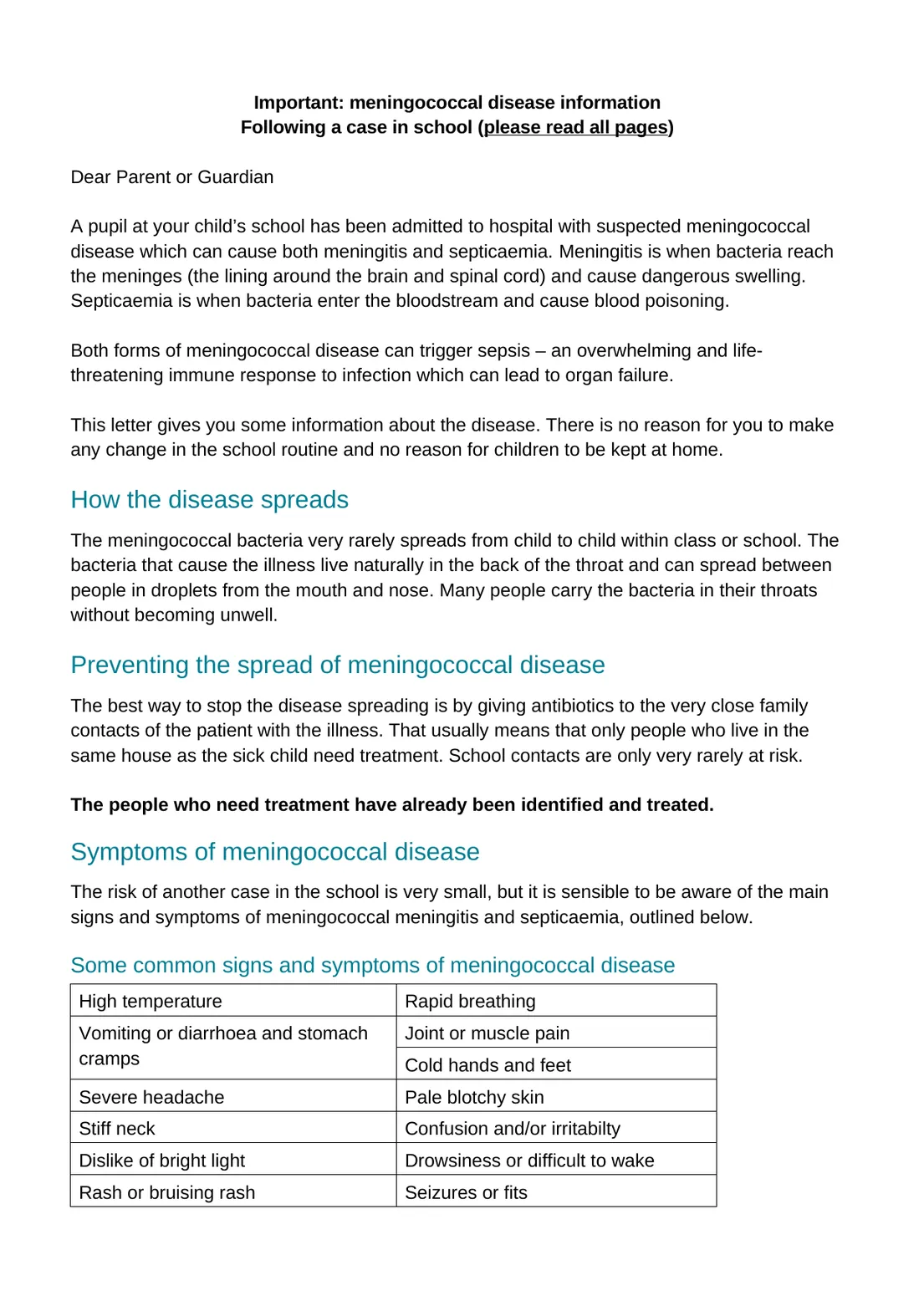
Important: meningococcal disease information
A pupil at your child’s school has been admitted to hospital with suspected meningococcal disease which can cause both meningitis and septicaemia. Meningitis is when bacteria reach the meninges (the lining around the brain and spinal cord) and cause dangerous swelling. Septicaemia is when bacteria enter the bloodstream and cause blood poisoning.
- 19.8 → 7.9平均每句字數
- 169待接受或拒絕的修訂新增與刪除內容
- 0除所要求的拼字錯誤修復外,標題、樣式或表格儲存格皆無變更
- 2要求 2 觸及的段落,且無其他變更
開啟真實檔案
這些是執行過程中的實際檔案。下載後以 Word 開啟:修訂副本會標示出每一處變更。
檔案來源: GOV.UK, 英國健康安全局,「學校出現腦膜炎雙球菌疾病病例後與家長的溝通」(腦膜炎雙球菌疾病管理指引)。包含在開放政府授權條款 v3.0 下授權的公共部門資訊。英國健康安全局(UKHSA)未審閱或背書此範例。
01 · 起始檔案
一份包含自訂樣式及合併表格的三頁範本
信件解釋了腦膜炎、敗血症和膿毒症、誰會獲得抗生素、何時撥打 NHS 111 或 999,以及兒童在什麼年齡接種何種疫苗。句子長度約為 20 個字,並包含如「腦膜」和「強烈的免疫反應」等詞彙。
這是一個真實的 Word 範本:包含自訂標題和內文樣式、項目符號樣式的兩個慈善機構聯絡人、黃色的「插入聯絡資料」佔位符,以及一個左側欄位合併了兩列的 13 項症狀表格。所有這些內容都必須在改寫中保留下來。
02 · 要求 1
「為識字率較低的家長進行改寫,並以修訂標記顯示」
健康保護團隊輸入的內容
This is the UKHSA template letter to parents after a school case of meningococcal disease (3 pages). Please rewrite the body text so parents with low literacy can follow it - short sentences, everyday words, reading age about 9-11.

- Keep every medical fact: what meningitis, septicaemia and sepsis are, who gets antibiotics, when to call NHS 111 or 999, and all the vaccine ages
- Keep the four section headings and the symptoms table as they are - in the table only fix the typo 'irritabilty'
- Keep the two charity contacts and the yellow 'insert contact...' placeholders in the last paragraph unchanged
- Keep the existing paragraph styles

Please do it as tracked changes in this same Word file, so our consultant can accept or reject each edit.
的處理方式
- 將內文段落改寫為短句和日常用語:「腦膜」(meninges)變更為「包圍腦部和脊髓的襯裡」。
- 保留了要求中所列的每一個醫學事實,包括所有疫苗接種年齡及 25 歲的補種資訊。
- 保留了四個標題、兩個慈善機構聯絡人以及黃色佔位符;在表格中,僅修正了「irritabilty」(煩躁)的拼字錯誤。
- 保留了每一個段落樣式及合併的表格儲存格。
- 交付了兩次信件:一份是乾淨的新版本,另一份是將每一處編輯都標記為 Word 修訂的原始副本。
Important: meningococcal disease information
Following a case in school (please read all pages)
Dear Parent or Guardian
4A pupil at your child’s school has been admitted to hospital with suspectedis in hospital. Doctors think it is meningococcal disease which. This disease can cause both meningitis and septicaemiatwo illnesses. One is meningitis. Meningitis is when bacteriameans germs reach the meninges (the lining around the brain and spinal cord) and cause. The lining swells, and this is very dangerous swelling. The other illness is septicaemia. Septicaemia is when bacteria enter the bloodstream and cause blood poisoning. means germs get into the blood. They poison the blood.
Both forms of meningococcal disease can trigger sepsis – an overwhelming and life-threatening immune response to infection which can lead to organ failure. illnesses can cause sepsis. Sepsis is when the body fights infection too hard. This can harm the body a lot. It can stop organs from working. It can kill.
This letter givestells you some information about the disease. There is no reason for you to make any change in the school routine and no reason for children to be keptPlease do not worry. Your child can still go to school. School will run as normal. No child needs to stay at home.
How the disease spreads
The meningococcal bacteria very rarely spreads from child to child withinThis disease does not often spread in class or school. The bacteria that cause the illness live naturally ingerms live at the back of the throat and can spread between people in droplets. They pass in tiny drops from the mouth and nose. Many people carry the bacteria in their throats without becoming unwellgerms. They do not feel ill.
Preventing the spread of meningococcal disease
The best way toAntibiotics stop the disease from spreading. is by giving antibiotics to theOnly very close family contacts of the patient with the illnessneed them. That usuallyoften means that only people who live in the same house as the sick child need treatment. School contacts are only very rarely at risk. home. Children at school are almost never at risk.
The people who need treatment have already been identified and treatedhealth team has found those people. They have had their treatment.
Symptoms of meningococcal disease
The risk of anotherAnother case in the school is very small, butunlikely. But it is sensible to be aware ofhelps to know the main signs. and symptoms of meningococcal meningitis and septicaemia, outlined below. You can see them in the table below.
Some common signs and symptoms of meningococcal disease
High temperature
Rapid breathing
Vomiting or diarrhoea and stomach cramps
Joint or muscle pain
Cold hands and feet
Severe headache
Pale blotchy skin
Stiff neck
Confusion and/or irritabiltyirritability
Dislike of bright light
Drowsiness or difficult to wake
Rash or bruising rash
Seizures or fits
OneYou may see one or more of these symptoms may develop and they can appearsigns. They can come in any order.
Meningococcal disease can be hard to identify at first because it can be like a bad case of flu. However, anyone affected with meningococcal disease will usually become seriously ill within a few hours. You should keep checking your child if they are unwell and contact your GP (family doctor) or NHS 111 for advice if you have any concerns. At first it can look like flu. So it can be hard to spot. A sick person can get very ill within hours. Keep checking your child if they feel unwell. If you are worried, call your GP or NHS 111.
If you becomeare worried about your child’s condition, particularly if they are getting worse, seek medical help urgently at the closest A&E Department or by dialling 999. , act fast. If your child gets worse, get help urgently. Go to A&E or call 999.
Be watchful and use your instincts. Early treatment can be life savingKeep a close watch. Trust what you feel. Getting help early can save a life.
Protecting against meningococcal disease
It is important to be aware that meningococcal disease is caused by different groups of meningococcal bacteria. In the UK meningococcal disease is almost always caused by one of four meningococcal groups commonly known as MenB, MenC, MenW or MenY. These groups of meningococcal disease can be prevented with vaccines. MenA disease is rare in the UK but this can also be prevented by vaccinationMany types of germs cause this disease. In the UK it is almost always MenB, MenC, MenW or MenY. Vaccines can stop these types. MenA is rare in the UK. A vaccine can stop MenA too.
The following meningococcalUK gives these vaccines are offered as part of theas routine UK schedule:
MenB vaccine (which protects againststops most cases of MenB disease), routinely offered as. Babies get 3 doses given as part of the infant immunisation programme. They get them at 8 weeks, 16 weeks and 12 months of age. Children born in the UK. All children born on or after 1 May 2015 have beenwere offered this vaccine.
Hib-MenC vaccine (which protects againststops MenC disease), routinely offered. Children get it at 12 months. asIt is part of the routine childhood immunisation programmevaccine plan.
MenACWY vaccine (which protects againststops MenA, MenC, MenW and MenY disease) routinely offered. Young people get it at 13 to 15 years of age. old.
AnyoneDid your child miss the teen MenACWY vaccine? If they were born on or after 1 September 1996 who was eligible but missed their teenage MenACWY vaccine can still have the vaccine, they can still have it. They can have it up to their 25th birthday. Anyone who isAre you older and starting university for the first time? You can still have the vaccineit up to theiryour 25th birthday. For a young personIf your child is still at school speak to their, ask the school provider to arrange vaccination otherwise you will need to make an appointment with theirvaccine team. If not, book with your GP practice.
Please ensurecheck your child is up to date with their routine vaccinations with their. Ask your GP practice. Even if theyyour child had MenC vaccine when they were younger, it is important that teenagers get the MenACWY vaccine as it boosts protection against MenC disease and protects against more groups of meningococcal disease. as a baby, they still need MenACWY as a teen. It boosts MenC cover. It also guards against more types.
Be watchfulWatch for signs and symptoms even if your child is up to date with their vaccinations as available vaccines do not protect against all causes of the diseaseafter vaccines. Vaccines do not stop every cause.
All meningococcal vaccines offered to eligible children as part of routine programmes are freely available on the NHS. Vaccines may be available privately for those who are not eligible under these programmes. Meningococcal disease can affect anyone of any age but the national immunisation programmes targetRoutine vaccines are free on the NHS for eligible children. If you are not eligible, you may pay for them privately. This disease can affect any age. But the NHS plan guards those most at risk.
Further information on meningococcal disease is available from:
8• The Meningitis Research Foundation, www.meningitis.org telephone: 0808 800 3344
11• Meningitis Now, www.meningitisnow.org telephone: 0808 80 10 388 helpline email address: [email protected]
16If you need further support or advice, please contact insert contact details or call us insert contact telephone number.
19我們檢查了: 修訂副本有 71 處新增和 98 處刪除;段落樣式與範本完全對應;五個標題皆無變更;表格維持 7 列 2 欄及其合併儲存格,且唯一變更是「irritability」(煩躁);疫苗年齡、NHS 111、999、急診(A&E)以及兩個慈善機構聯絡資料均已呈現;佔位符保留了黃色標示。
03 · 要求 2
「接受所有修訂,然後以新增修訂標記的方式進行兩處編輯」
健康保護團隊輸入的內容
The consultant has reviewed it. Please:
1. Accept all the tracked changes from your rewrite.
2. Make sure the word 'septicaemia' is used (not replaced by a simpler word), with a short explanation in brackets the first time it appears, e.g. 'septicaemia (blood poisoning)'.
3. In the last paragraph, replace 'insert contact details' with 'the Thames Valley Health Protection Team' and 'insert contact telephone number' with '0344 225 3861', and remove the yellow highlight.

Make changes 2 and 3 as new tracked changes.
的處理方式
- 基於乾淨的版本進行工作,即已接受所有要求 1 變更的信件。
- 保留了「敗血症」(septicaemia)一詞,並在第一次出現時加上了「(血液中毒)」的解釋。
- 以團隊名稱和電話號碼取代了兩個佔位符,並移除了黃色標示。
- 交付了一份僅顯示這些變更的新修訂版副本。
A pupil at your child’s school is in hospital. Doctors think it is meningococcal disease. This disease can cause two illnesses. One is meningitis. Meningitis means germs reach the lining around the brain and spinal cord. The lining swells, and this is very dangerous. The other illness is septicaemia (blood poisoning). Septicaemia means germs get into the blood. They poison the blood.
Protecting against meningococcal disease
If you need further support or advice, please contact insert contact detailsthe Thames Valley Health Protection Team or call us insert contact telephone number0344 225 3861.
我們檢查了: 新修訂版副本包含 3 處新增和 2 處刪除,皆位於該兩個段落中;最後一段未留下任何標示;樣式和表格皆無變更。
04 · 要求 3
「最終信件的波蘭語譯本」
健康保護團隊輸入的內容
Now make a Polish translation of the final letter as a separate Word file. Translate the accepted text only - the Polish copy should have no tracked changes. Keep the same headings, styles and the 2-column symptoms table, and leave all phone numbers, web addresses, the email address and the vaccine names (MenB, Hib-MenC, MenACWY) exactly as they are.
的處理方式
- 從最終信件製作了一個獨立的 Word 檔案並進行翻譯,檔案中沒有任何修訂標記。
- 保留了範本的樣式、標題以及帶有合併儲存格的雙欄症狀表格。
- 保留了 999、NHS 111、所有電話號碼、兩個網址、電子郵件地址,以及 MenB、Hib-MenC 和 MenACWY,皆保持原樣。
Ważne: informacje o chorobie meningokokowej
Po przypadku zachorowania w szkole (prosimy przeczytać wszystkie strony)
Szanowni Rodzice i Opiekunowie
Uczeń ze szkoły Państwa dziecka przebywa w szpitalu. Lekarze podejrzewają chorobę meningokokową. Choroba ta może wywołać dwie choroby. Jedną z nich jest zapalenie opon mózgowych. Zapalenie opon mózgowych oznacza, że zarazki docierają do błon otaczających mózg i rdzeń kręgowy. Błony te puchną, a to jest bardzo niebezpieczne. Drugą chorobą jest posocznica (zakażenie krwi). Posocznica (zakażenie krwi) oznacza, że zarazki dostają się do krwi. Zatruwają krew.
Obie choroby mogą prowadzić do sepsy. Sepsa występuje wtedy, gdy organizm zbyt mocno walczy z zakażeniem. Może to bardzo uszkodzić organizm. Może spowodować, że narządy przestaną działać. Może prowadzić do śmierci.
Ten list zawiera informacje o tej chorobie. Prosimy się nie martwić. Państwa dziecko może nadal chodzić do szkoły. Szkoła będzie działać normalnie. Żadne dziecko nie musi zostawać w domu.
Jak rozprzestrzenia się choroba
Choroba ta rzadko rozprzestrzenia się w klasie lub w szkole. Zarazki żyją w tylnej części gardła. Przenoszą się w drobnych kropelkach z ust i nosa. Wiele osób nosi te zarazki. Nie czują się chore.
Zapobieganie rozprzestrzenianiu się choroby meningokokowej
Antybiotyki powstrzymują rozprzestrzenianie się choroby. Potrzebują ich tylko bardzo bliskie kontakty rodzinne. Zwykle oznacza to tylko osoby mieszkające w tym samym domu. Dzieci w szkole prawie nigdy nie są zagrożone.
Zespół ds. zdrowia odnalazł te osoby. Otrzymały one leczenie.
Objawy choroby meningokokowej
Kolejny przypadek zachorowania w szkole jest bardzo mało prawdopodobny. Warto jednak znać główne objawy. Można je zobaczyć w poniższej tabeli.
Niektóre częste oznaki i objawy choroby meningokokowej
Wysoka gorączka
Szybkie oddychanie
Wymioty lub biegunka i bóle brzucha
Ból stawów lub mięśni
Zimne dłonie i stopy
Silny ból głowy
Blada, plamista skóra
Sztywność karku
Dezorientacja i/lub drażliwość
Unikanie jasnego światła
Senność lub trudności z obudzeniem
Wysypka lub wysypka z siniakami
Drgawki lub napady drgawek
Może wystąpić jeden lub więcej z tych objawów. Mogą pojawić się w dowolnej kolejności.
Na początku może to wyglądać jak grypa. Dlatego trudno to rozpoznać. Chora osoba może bardzo ciężko zachorować w ciągu kilku godzin. Obserwuj dziecko, jeśli źle się czuje. Jeśli się martwisz, zadzwoń do lekarza rodzinnego (GP) lub pod numer NHS 111.
Jeśli się martwisz, działaj szybko. Jeśli stan dziecka się pogarsza, poszukaj pomocy natychmiast. Zgłoś się na SOR (A&E) lub zadzwoń pod numer 999.
Uważnie obserwuj dziecko. Ufaj temu, co czujesz. Wczesna pomoc może uratować życie.
Ochrona przed chorobą meningokokową
Tę chorobę wywołuje wiele rodzajów zarazków. W Wielkiej Brytanii prawie zawsze są to MenB, MenC, MenW lub MenY. Szczepionki mogą chronić przed tymi typami. MenA występuje w Wielkiej Brytanii rzadko. Szczepionka chroni również przed MenA.
W Wielkiej Brytanii rutynowo podaje się następujące szczepionki:
Szczepionka MenB chroni przed większością zachorowań wywołanych przez MenB. Niemowlęta otrzymują 3 dawki. Podaje się je w 8. tygodniu, 16. tygodniu i 12. miesiącu życia. Tę szczepionkę zaproponowano wszystkim dzieciom urodzonym 1 May 2015 lub później.
Szczepionka Hib-MenC chroni przed chorobą wywołaną przez MenC. Dzieci otrzymują ją w 12. miesiącu życia. Jest ona częścią rutynowego kalendarza szczepień.
Szczepionka MenACWY chroni przed chorobami wywołanymi przez MenA, MenC, MenW i MenY. Młodzież otrzymuje ją w wieku od 13 do 15 lat.
Czy Twoje dziecko pominęło szczepienie MenACWY dla nastolatków? Jeśli urodziło się 1 September 1996 lub później, nadal może je otrzymać. Może je otrzymać do swoich 25. urodzin. Czy jesteś osobą starszą i po raz pierwszy zaczynasz studia? Nadal możesz je otrzymać do swoich 25. urodzin. Jeśli Twoje dziecko nadal chodzi do szkoły, zapytaj szkolny zespół ds. szczepień. Jeśli nie, umów się w przychodni lekarza rodzinnego.
Sprawdź, czy Twoje dziecko ma aktualne szczepienia. Zapytaj w przychodni lekarza rodzinnego. Nawet jeśli Twoje dziecko otrzymało szczepionkę MenC jako niemowlę, jako nastolatek nadal potrzebuje szczepionki MenACWY. Wzmacnia ona ochronę przed MenC. Chroni też przed większą liczbą typów.
Obserwuj objawy nawet po szczepieniach. Szczepionki nie chronią przed każdą przyczyną choroby.
Rutynowe szczepionki są bezpłatne w ramach NHS dla uprawnionych dzieci. Jeśli nie są Państwo uprawnieni, mogą Państwo zapłacić za nie prywatnie. Choroba ta może dotknąć osoby w każdym wieku. Program szczepień NHS chroni jednak osoby najbardziej zagrożone.
Dodatkowe informacje na temat choroby meningokokowej są dostępne w:
• The Meningitis Research Foundation, www.meningitis.org telefon: 0808 800 3344
• Meningitis Now, www.meningitisnow.org telefon: 0808 80 10 388 adres e-mail infolinii: [email protected]
Jeśli potrzebują Państwo dodatkowego wsparcia lub porady, prosimy o kontakt z Zespołem Ochrony Zdrowia Thames Valley lub o telefon pod numer 0344 225 3861.
我們檢查了: 檔案中無修訂標記;維持相同的段落樣式和 7 × 2 表格;疫苗接種年齡顯示為「8. tygodniu」、「16. tygodniu」、「12. miesiącu」、「od 13 do 15 lat」和「25. urodzin」;聯絡欄位列出了 Thames Valley 團隊及 0344 225 3861。
值得了解: 此要求首次執行時,波蘭語譯本是根據要求 2 之前的信件製作的。我們修正了 標記檔案最新版本的方式,此處顯示的副本為同一對話中重新執行的相同要求。
您的審閱者可以逐一接受的編輯
大多數 AI 工具僅能提供供您貼上的改寫文本。 直接在您的 Word 檔案中進行編輯,保留原有的樣式和表格,將變更以真實的 Word 修訂標記呈現,並翻譯您批准的版本。
繼續閱讀